
Nichole’s Journey to Peer Mentorship
Trauma doesn’t end in the hospital. Even with excellent medical care and dedicated support, there is a moment when survivors begin to process what has happened and what comes next. I experienced that shift during my own recovery, as I started to understand how profoundly my life had changed. That realization showed me how critical connection and understanding are during recovery. Through the Trauma Survivors Network, peer mentors provide support rooted in lived experience. We meet patients where they are and remind them that they are not alone when navigating what comes next.
My connection to our community’s trauma center began unexpectedly the week before my accident, when two friends were hit by a drunk driver. One of them, Marylou- my guardian angel, passed away, and the other Butch, was airlifted to Gulf Coast Hospital Trauma Center. In the days that followed, our community rallied around Butch and Marylou’s family. The following weekend, our island town came together to raise money to help with hospital expenses and show support by coming together and listening to music on the water from our boats and collecting donations and words of encouragement.

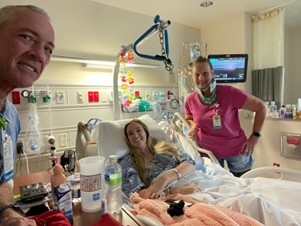
Still grieving on the way home from that event, life threw us another surprise-an accident. Our small boat hit a wave wrong, spun out launching me into the water and the propeller struck me. In a matter of seconds, I was on my way to becoming a trauma patient at the very same hospital.
To save my life, the trauma team faced extraordinary challenges. I required massive blood transfusions, repeated life saving interventions, and aggressive infection control. As a result of my injuries, my left leg and part of my pelvis were amputated. I later learned that my surgery resulted in the rarest amputation, shared by fewer than 1% of amputees. That meant my life would look very different and walking again would be extremely challenging. In that moment, I wasn’t just grieving what I had lost, I was trying to understand who I would be moving forward.
My care team and the hospital staff were essential to my healing, but the peer mentors provided something different. Through the Trauma Survivors Network, I connected with peer mentors who brought lived experience. They served as an example of a full life I wanted so badly to move towards. They understood what it felt like to wake up in a hospital bed without warning, unsure when you would return home. Their time was not limited the way staff’s was at time, and they offered an understanding that only someone who has been there can provide.
In addition to my peer mentors, I was surrounded by extraordinary support from my community. My room was filled with photos, flowers, signs, and cards. One evening after visiting hours ended, I looked around and was struck by the realization of how fortunate I was. My cup was overflowing and I knew many others facing trauma whose cups were empty. That realization stayed with me. I promised myself that I would come back and share the support I had been given.
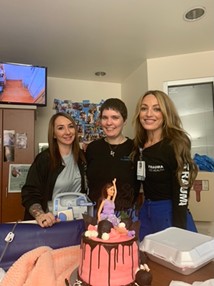
I was in the hospital for almost two months and made many friends. I look back and think fondly on my time there although there were unimaginable challenges. On the day I was discharged, the staff surprised me with a cake topped with a Barbie doll. They had removed the doll’s left leg in honor of my own experience. I felt sad to leave the people who had become such a meaningful part of my life, but hopeful of taking the next steps in recovery.
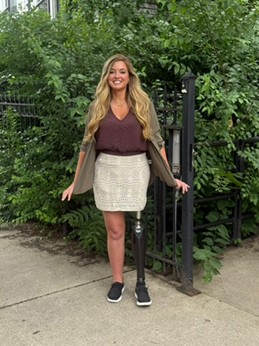
I left the hospital and took the time I needed to heal. I met my first goal- walking down the aisle at my best friend’s wedding. I was her maid of honor and used my new prosthetic which she humorously named “Peggy” like a pirate peg leg, because I lost my leg at sea. Then I met my next goal and all of a sudden I was surpassing all of the expectations I had set for myself. My mobility may be limited as a hemi-pelvectomy. With current technology, I’ll never be able to run or go upstairs, because I lost the movement in my hip unlike more common amputees. However, I made a choice that nothing could limit my happiness. It was a choice that was easier because of the people I met during my time in the hospital.

One year later, I walked back through the doors of the Trauma Units, not as a patient this time, but as a Peer Mentor with the Trauma Survivors Network. I quickly learned that this role is not only about offering encouragement. It’s about connection. Sitting with someone during one of the most difficult moments of their life, sharing lived experience, and helping them recognize their own strength has been just as transformative for me as it has been for those I support. I often leave the rooms wondering if I made as big of an impact on them as they did on me. I may never know, but I am encouraged when they ask for me to come back.
There are many moments that stay with me. I once spent hours sitting with a young girl who had lost her leg mainly listening and being present, quietly sharing moments of my experience that helped me get through, hoping it may help her as well. I went back several times at her request. Afterward, I carried her with me, praying I had helped in some small way. Later, she wrote to me and said that I felt like a big sister and I was someone who helped her get through one of the hardest moments in her life. I also sat with a teenager who had been seriously injured in a car accident. The next time I saw her, she told me she had been struggling during therapy earlier that day but remembered my story. She told her therapists, “If Nichole can do it, so can I.” I’ve received feedback from nurses who once cared for me on how they see changes in the people I’ve met. I’ve changed too for the better and that’s more than enough for me to continue this mission.
The patients I meet have full lives ahead of them beyond the hospital. I remind them often that the strength they are discovering now, while facing something they never asked for, will stay with them long after this chapter ends. Every person I’ve met through this has gained something powerful- strength, and that strength will carry them through challenges for the rest of their lives.
Volunteering as a peer mentor has shown me that healing doesn’t happen in isolation. It happens through connection, shared experience, and the simple act of showing up for one another. The Trauma Survivors Network has created a space for that kind of healing at a time when it matters the most. I am honored to be a part of the program that reminds survivors that they are not alone and that life after trauma can still be full, purposeful, and strong.