
In November 2010, I was run over by a truck while riding my bicycle to work in a city bike lane. My left leg was crushed by the truck’s tires. I had broken ribs, a fractured pelvis, and extreme blood loss. A team of trauma surgeons saved my life, but they had to amputate my leg above the knee to do so. I was traumatized. Each night, when I closed my eyes, I relived the accident. The world was suddenly a dangerous place, and I had no idea how I would move forward in it.
Two months later, I was transferred to an inpatient rehabilitation hospital. It was there that I met my “first” amputee.
Rob was assigned to be my peer mentor. He was about my age, and he had an above-knee amputation like mine. He stopped in after dinner one night to meet me and answer any questions I had.
I had none. I was riddled with pain from a limb that didn’t exist. My phantom toes felt like they were crammed underneath my phantom knee. My body was a mess of incisions and sutures. I was overwhelmed and panicked by wound care.
The old me would have wanted to know Rob – to hear what he had to say — but this new me didn’t have the energy. I could barely get through a day; how could I live like this for the rest of my life?
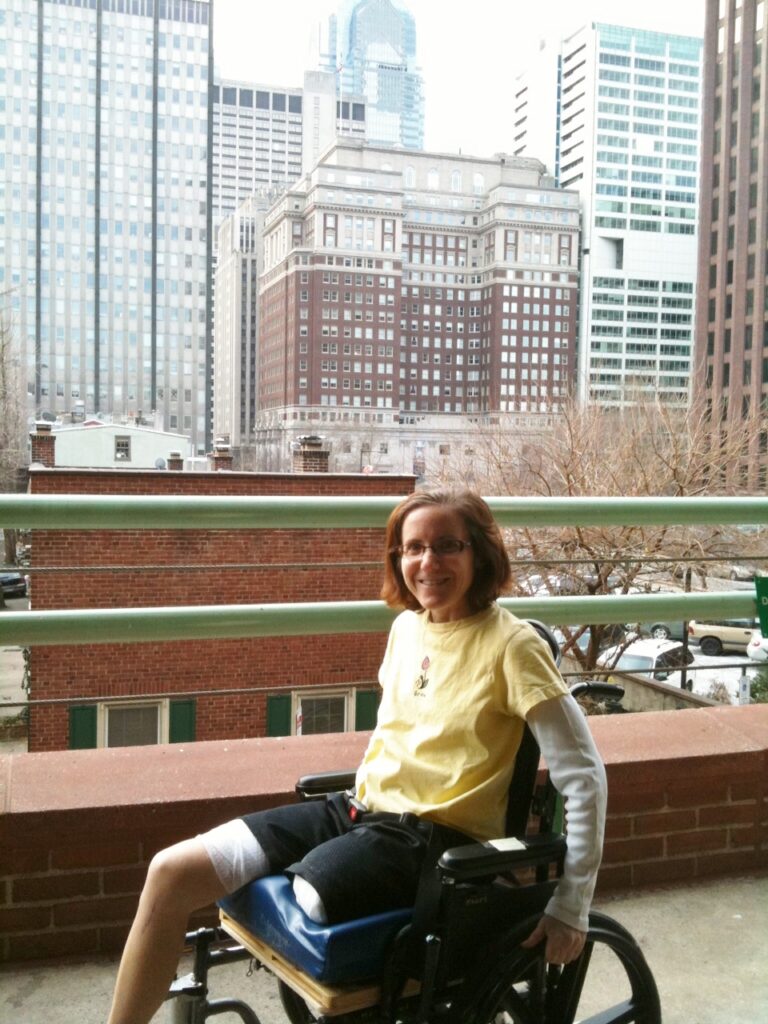
I’m sure Rob sensed my ambivalence. But my parents were there too. And they had questions. They asked Rob about his prosthetic socket, the fitting process, the modifications he used at home. They asked about travel, family, and relationships. Rob stayed for almost two hours that night. He shared his knowledge and experiences. But, even now, I don’t remember a single thing he said.
What I do remember is this: Rob came to visit me in the evening — after going to work and the gym.
That’s what stuck with me. That image of him standing there in his rip-away gym pants.
Rob goes to work. Rob goes to the gym.
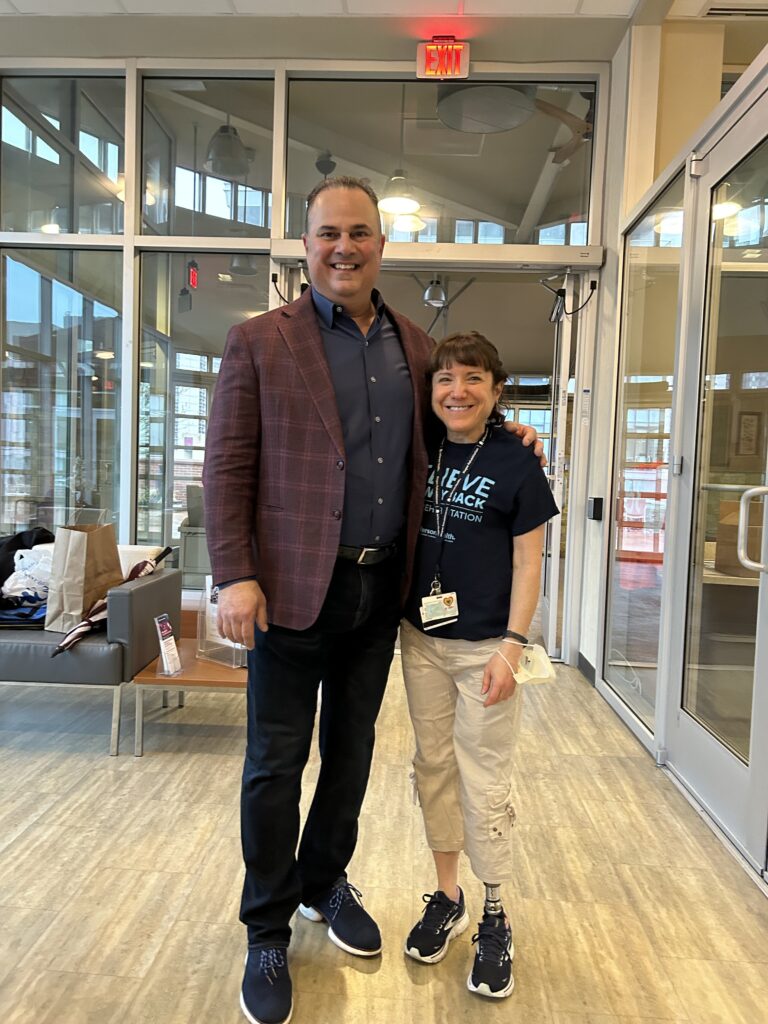
It was a vision that gave me hope.
Over the next year, I was fitted with my first prosthesis. In physical therapy, I learned to walk again – first with crutches, then with a cane, and finally with my prosthesis alone. It was challenging, but the second year brought even more independence. I joined our hospital’s amputation support group. I returned to work part-time and went back to the gym – like Rob!
The following year, I decided to become a peer mentor myself. I signed up for training, where I learned the responsibilities, the importance of listening, and different ways to provide support for new amputees and their families. With other mentors-in-training, I spent hours on role plays and sample questions.
I quickly realized that being a peer mentor is unpredictable – just like living with amputation. Every patient and family is different. Some ask questions. Some tell stories. Some want to see my prosthesis, share their goals, and talk about the future. Others are silent and shell-shocked, like I was.
I learned that peer mentoring isn’t always about imparting knowledge. It’s about meeting people where they are – and being who you are.
Now, more than a decade later, I’ve switched careers. I coordinate the amputation support program at Jefferson Moss-Magee Rehabilitation Center City, the same hospital where I did my own rehabilitation. I facilitate our monthly support group and match patients and families with peer mentors who can help them move forward.
When I train new mentors for our program, I teach about listening, asking questions, sharing knowledge, demonstrating skills, and giving tips. But their most common question is, “What can I say that’ll make a difference?”
So I tell them about Rob. My peer mentor. My “first” amputee.
And how — just by showing up — he gave me hope. A vision of what’s possible.
That’s the power of peer mentoring.
By Rebecca Levenberg
Coordinator of amputation support at Jefferson Moss-Magee Rehabilitation in Philadelphia and a traumatic injury survivor