
Strengthening Care Through Caregiver Support
At Atrium Health Carolinas Medical Center’s Trauma Survivors Network program, we offer several different support groups, including Adult Survivors, Teens & Young Adults, Tweens, and Family & Friends. In the Family & Friends group, I noticed that there is a consistent group of women who have shown up to the group for years, whereas in the other groups, the attendance ebbs and flows with participants coming when they need it but not usually long-term. I was curious about what kept this group of caregivers coming back to the Family & Friends group so consistently, so I decided to pursue a research study to investigate further. The objective of this study was to determine the impact of support groups on the emotional wellbeing and recovery of caregivers of traumatic injury survivors.
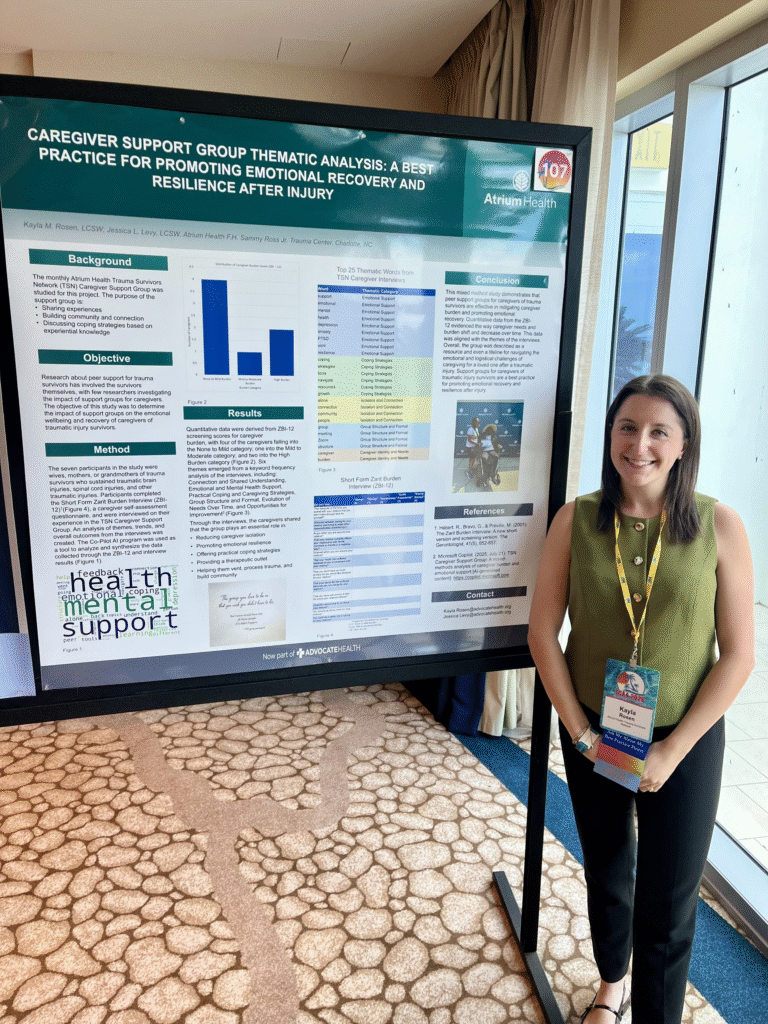
Through our IRB, I designed the study, collected the data, and analyzed the results. I had seven participants join the study, all wives, mothers, or grandmothers of trauma survivors who sustained traumatic brain injuries, spinal cord injuries, and other trauma related injuries from car accidents, gunshot wounds, diving accidents, etc. It was a mixed-methods study design, including qualitative data collected through individual interviews with the participants as well as quantitative data collected through a caregiver burden screening tool called the Short Form Zarit Burden Interview (ZBI-12) to measure caregiver burden levels. A thematic analysis was conducted through coding the interview transcriptions for words and phrases.
The major themes that emerged from the analysis include Connection and Shared Understanding, Emotional and Mental Health Support, and Practical Coping and Caregiving Strategies. The integration of ZBI-12 quantitative scores with qualitative themes revealed a spectrum of caregiver burden and emotional resilience of this group of caregivers. Participants with higher burden scores described the support group as crucial for surviving the early recovery period, while those with lower scores described transitioning into mentoring roles, which provides them with a sense of value and pride. The results demonstrate that peer support groups for caregivers of trauma survivors are effective in mitigating caregiver burden and promoting emotional recovery. The group provides a meaningful space for connection, learning, and post-traumatic growth. Through the interviews, the caregivers shared that the group plays an important role in reducing caregiver isolation, promoting emotional resilience, and discussing practical coping strategies. The participants focused on the value of connecting over a shared experience in a group environment where they feel consistently seen, heard, and supported. Overall, the group was described as a resource and even a lifeline for navigating the emotional and logistical challenges of caregiving for a loved one after a traumatic injury.
Thank you to the participants who were willing to join the study and be a part of advancing the research on peer support for caregivers of traumatic injury survivors. You can find the full study and results in the TSN Coordinator Library.