The 2026 Stories in Art Ornament
Inspired by Amanda Kern, LCSW
TSN Coordinator and Trauma Social Worker, R Adams Cowley Shock Trauma Center
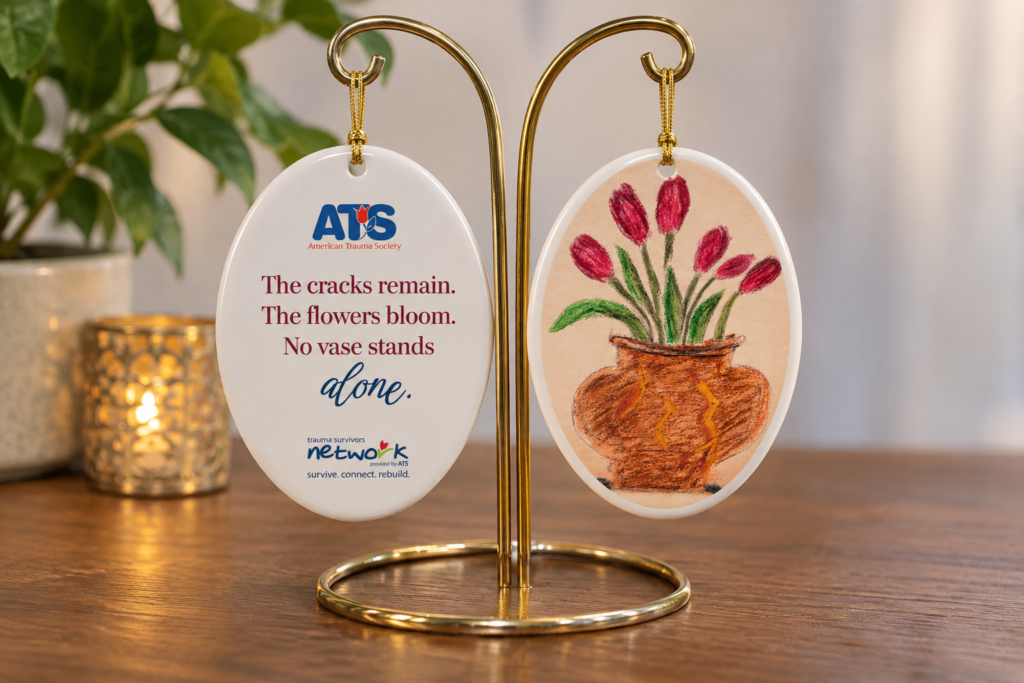
Their stories aren’t finished. The clay vase represents a trauma survivor. Its cracks reflect the visible and invisible ways an injury can change someone’s life. But the vase is still standing, still capable of holding something. Sometimes what it carries may feel unbearably heavy, like a vase filled with rocks. Sometimes it may feel so fragile that being handled carelessly seems terrifying. And sometimes, it holds flowers.
When I worked as a social worker on our trauma units, one of the simplest yet most meaningful things I did was make clay handprints for patients nearing the end of their lives. We would gently rub the patient’s hand with lotion, press their hand into the clay, let the impression dry, and give it to their family. Long after the patient was gone, they would still have something they could touch, an imprint of their loved one. There was always something solemn about that work. But what about the survivors? They’re still here, even if their bodies have changed in ways they never imagined. They may be learning how to live with injuries, limitations, memories, or losses that weren’t part of their lives before.
The gold running through the cracks is inspired by kintsugi, the Japanese art of repairing broken pottery without hiding where it fractured. For me, it represents the Trauma Survivors Network. Peer support doesn’t undo an injury or restore someone’s life to exactly what it was before. But it can offer a different way to see the parts of ourselves and our experiences that we might otherwise feel compelled to hide or ashamed of.
The six tulips represent survivors from the six floors of R Adams Cowley Shock Trauma Center from the Trauma Resuscitation Unit (TRU) to the Shock Trauma Outpatient Pavilion. They also represent what happens when survivors find one another. Through our Peer Visitation program, I’ve heard survivors describe how meaningful it was to speak with another survivor. They might have caring families and friend and dedicated care teams. Yet sometimes, another survivor is the first person who makes them feel truly understood. The tulips don’t cover the cracks. They don’t make the vase something it wasn’t before. They offer something new to hold: connection, understanding, and the possibility of feeling less alone.
I used to make impressions in clay so families could hold on to someone they were losing. Now, as TSN coordinator, I’m more of a florist. I don’t grow the tulips, and I’m not there to hide the cracks. I just try to make sure no vase has to stand empty. The beauty they create is all theirs.
Help More Survivors Find Connection
Through the Trauma Survivors Network, the American Trauma Society helps trauma centers connect survivors and families with peer support, resources, and a community that understands.
Stories in Art
When you think of trauma and recovery, what part of your story stands out to you? Create a drawing about what matters to you or what is unique to your experience with traumatic injury.
You don’t need to be an artist. Stories in Art is open to all ages and capabilities. We love all art, as long as its made my hand. Download the submission form and use colored pencils, crayons, markers, water colors, pastels, or whatever you like to create your picture and share your story.
Frequently Asked Questions
Who can submit art?
Anyone in the Trauma Survivors Network community can participate! Trauma Survivors, loved ones, friends, and trauma professionals are all invited to submit art. We encourage submissions from both children and adults. Stories in Art can be submitted at any time and submissions are accepted year round.
Do I need to be an artist?
Absolutely not! This is about sharing your story, not creating a perfect picture. Your art can be simple or detailed, colorful or black and white, serious or silly. Use crayons, colored pencils, markers, paint, or pastels. Just make it yours.
Why should I participate?
Because your story is worth sharing! Your art could help someone else feel connected to the TSN community, bring a smile to someone’s day, or simply give you an opportunity to create something meaningful. Stories in Art will be shared throughout the trauma community and each October, one piece of art will be chosen each October to represent the TSN in the annual ornament.
Can I create my art with someone else?
Absolutely! We welcome art created together. Participants of any age with a parent, child, caregiver, sibling, friend, Trauma Survivor, clinical staff, or another member of their community.
You can each contribute to the same drawing, work together on an idea, or have someone help you with part of your art. There is no requirement that one person create the entire piece on their own.
If you collaborate, please include the names of everyone who helped create the artwork when you submit it, if they would like to be recognized.
Is there an age requirement?
No! There is no minimum or maximum age to participate. We want everyone to have the opportunity to share their creativity. Children and adults can create artwork on their own, or children can have help from a parent, caregiver, family member, or another trusted person.